
If you rely on legacy media for your real estate pulse, you likely believe the Toronto market is a smoking crater. Headlines today are a relentless cycle of "condo apocalypses," interest rate terror, and a general sense of impending doom. For the average observer, the noise has reached a frequency where it is easier to tune out entirely than to search for the signal.
However, there is a profound disconnect between these sensationalist narratives and the "boots on the ground" reality of 2026. While mainstream outlets are incentivized to chase clicks with panic, the underlying data suggests a major shift in transaction volume and buyer sentiment is already well underway. This isn't a story of prices skyrocketing; it's a story of a market finally finding its feet.
Key Insight
This analysis distills the most contrarian and essential takeaways from current market dynamics. In a world of "doom and gloom," the reality is that the market is not just stabilizing—it is resetting for a new, more disciplined cycle.
Transactions, Not Prices, Mark the True Bottom
The most common analytical error is waiting for prices to spike before declaring a recovery. In professional circles, a market "bottoms" when fluidity returns. The context for our current state is staggering: in 2025, the Greater Toronto Area (GTA) saw a 25-year low of just 62,000 transactions. To put that in perspective, the population of the GTA has nearly doubled since the year 2000. We weren't just in a "slow" market; we were in a frozen one.
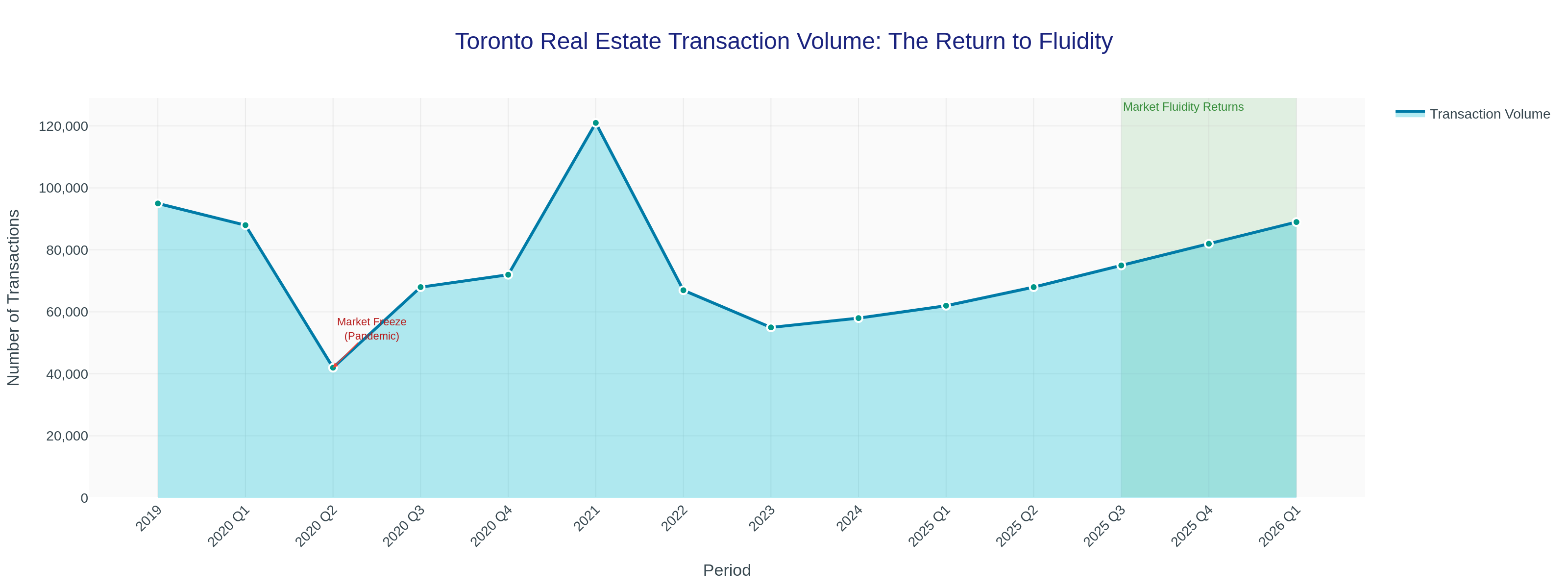
But early 2026 is telling a different story. Properties that sat dormant for six months are suddenly seeing action. This "capitulation"—where sellers finally price to the reality of the day—is a vital sign of health. As fluidity returns, the probability of a sale rises, creating the momentum necessary for a new cycle to begin.
"This is one of the things that's interesting for real estate professionals—they don't necessarily live in the price. They live in the transaction volume. The probability of a sale goes up regardless of the price, dependent upon how fluid the market is behaving and reacting to inventory."
The "Desensitization" Effect on Market Sentiment
For years, the market was paralyzed by "shock and awe" headlines. Whether it was the Bank of Canada's aggressive hikes or global "black swan" events, buyers would freeze. Today, the news cycle moves so fast that the "fear factor" has lost its edge.
Pre-2026: Paralysis by Analysis
- ●Every headline caused market freeze
- ●Buyers waited for "perfect" timing
- ●Fear drove every decision
2026: Desensitized Action
- ●Life milestones drive decisions
- ●News fatigue reduces panic
- ●"Need to get on with life" mentality
We have entered an era where geopolitical chaos is barely a 24-hour blip. People are becoming desensitized to the chaos. The prevailing sentiment has shifted from "waiting for the world to stop turning" to "I need to get on with my life." Human milestones—marriages, expanding families, and the need for more space—are finally outweighing the exhaustion of the news cycle.
The "European Model" and the End of the Ownership Dream
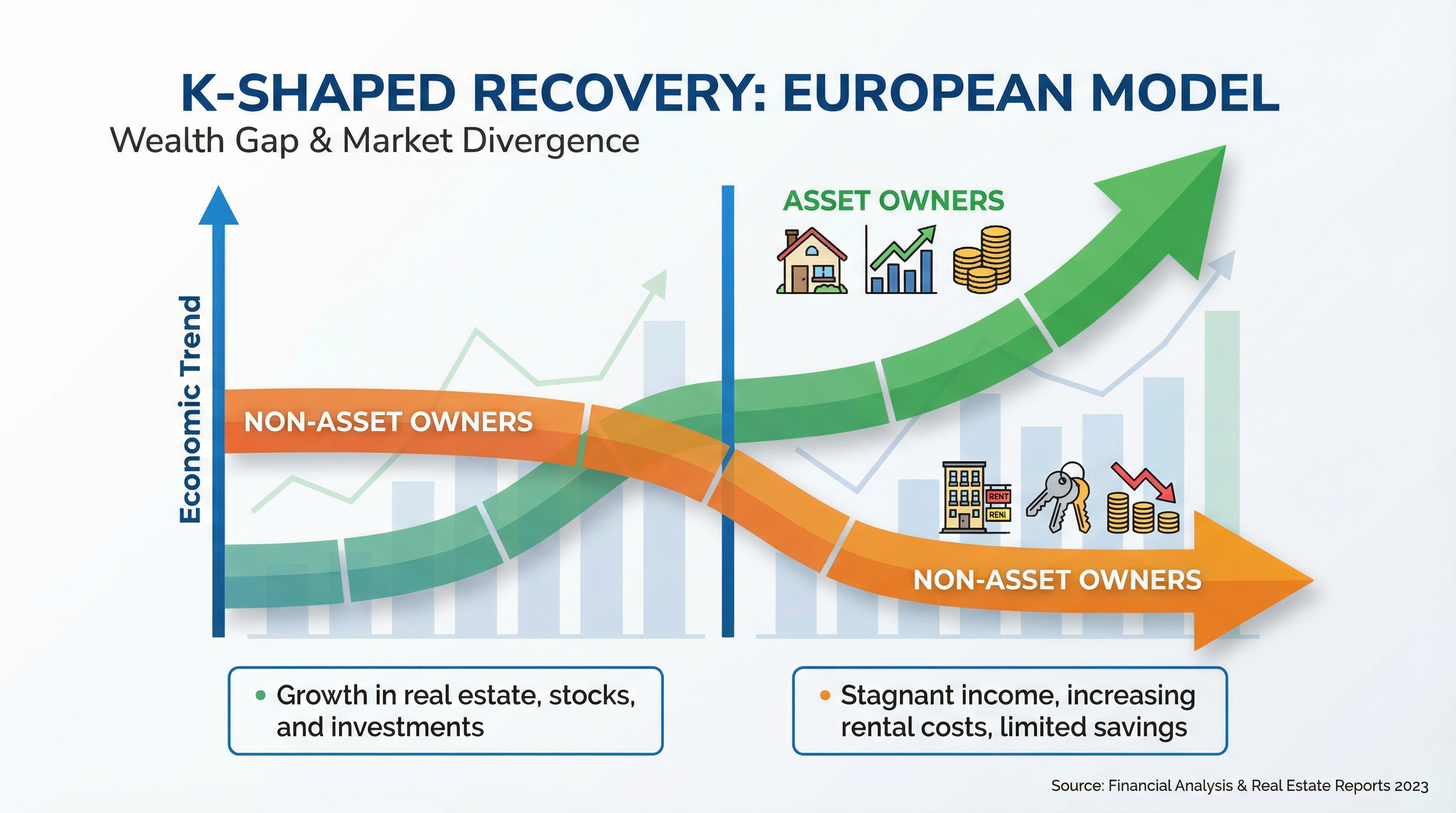
Beneath the stabilization lies a sobering shift in Toronto's social fabric. We are transitioning toward a "European model"—a K-shaped economy where the divide between asset owners and non-asset owners becomes permanent. Wealth is increasingly concentrated in institutional hands, REITs, and the "Bank of Mom and Dad."
Critical Social Shift
This is the death of real estate as a "get-rich-quick" scheme for the middle class. We are witnessing a move toward a utilitarian view of housing: a home is now simply a place to live, not a guaranteed wealth-generator for the next generation.
"An RCMP study recently predicted that by 2040, the social fabric of Canada could be ripped apart due to a massive distrust of institutions. When the ability to improve one's station is taken away, people don't just sit quietly—they vote to rip the system down."
This isn't just theory; we are seeing it in cities like New York, where "voting riots" have installed leaders who view property ownership itself as an outdated privilege to be dismantled.
The Surprising Case for the Resale Condo Market
The media loves to conflate the "pre-construction apocalypse" with the broader condo market. While developers are indeed struggling with stalled starts, the resale market is emerging as a massive value play. In many pockets of Toronto, resale condos are trading at roughly $800 per square foot—a price that is significantly below current replacement costs.
Furthermore, because new construction starts have effectively flatlined, the supply tap will be turned off for the next decade. For first-time buyers, the current "shadow inventory" of owners wanting to move up to freehold homes creates a unique window. Early 2026 has already seen multiple offers on one-bedroom and one-bedroom-plus-den units, signaling that savvy buyers are ignoring the headlines and looking at the math.
Strategy Over Timing: The New Rules of Engagement
Trying to time the absolute price floor is a gambler's errand. In this market, there is a distinct privilege in being an advisor because real value—true strategy—is only visible when the tide is out. Success in 2026 requires a disciplined approach to the "new normal":
📊 The "11 out of 10" Rule
In a bull market, people bought anything with a roof. In this market, you can buy an 11/10 property for a 9/10 price. Focus on quality, location, and lifestyle rather than just the lowest price-per-square-foot.
💰 Work on the "Bottom Number"
Sellers must be prepared for a range of outcomes. If you are listing your home, you must be comfortable with the bottom of a $100,000 price range. If you aren't, you aren't protecting your downside.
🏠 Sell Before You Buy
Unless you have exceptionally deep pockets, the "sure sale" is dead. Protecting your capital means ensuring your current asset is liquid before committing to the next.
🤝 Negotiate While Fear is High
It is far easier to find value when the general public is still terrified. Once the pendulum swings back toward optimism, the window for negotiation closes.
Conclusion: Moving Forward in the Pendulum Swing
The Toronto real estate market is a pendulum that has been pushed to a negative extreme. We have survived the fastest interest rate hikes in history, unprecedented policy shifts, and a global pandemic. The fact that the market has remained this resilient is a testament to real estate as a fundamental human need.
As we move through 2026, the question is no longer about market timing, but about life milestones.
Whether prices drop another 2% or 5% is less consequential than the return of fluidity. The "bottom" is not a date on a calendar; it is the moment when people stop watching the headlines and start making moves based on where they want to be five years from now.
Life goes on, and the market, finally, is following suit.
Ready to Navigate the 2026 Market?
Whether you're a buyer looking for value in the resale market or a seller testing the waters, understanding market fluidity is key to making informed decisions.
Related Market Analysis
2026 Canadian Housing Market Forecast
Comprehensive outlook on market trends, interest rates, and buyer/seller strategies for the year ahead.
First-Time Home Buyer Guide Toronto 2026
Navigate your first purchase with confidence in today's market conditions.
Best GTA Neighborhoods for Families 2026
Discover family-friendly areas with strong fundamentals and growth potential.
Homes for Sale in Toronto: 2026 Buyer Guide
Essential knowledge for navigating Toronto's evolving real estate landscape.