Moving to Toronto or the Greater Toronto Area is one of the biggest financial decisions you'll make. Whether you're relocating from Vancouver, Calgary, Montreal, or internationally, buying a home here comes with a unique set of challenges — and opportunities — that you won't fully understand from Googling "average home price Toronto."
This guide is built for out-of-town buyers. We skip the basics and focus on the things you can't learn until you're already here: the hidden costs, the neighbourhood trade-offs, the remote buying process, and the programs that can save you tens of thousands of dollars. Everything is sourced from government data and updated for early 2026.
What's in This Guide
The Real Cost of Housing in the GTA (2026)
National averages are misleading. The GTA is a patchwork of micro-markets where prices can vary by $300,000 between neighbourhoods 15 minutes apart. Here's what each property type actually costs in early 2026:
| Property Type | City of Toronto | Inner Suburbs | Outer Suburbs |
|---|---|---|---|
| Condo (1-bed) | $550K–$750K | $450K–$600K | $400K–$550K |
| Condo (2-bed) | $700K–$950K | $550K–$750K | $480K–$650K |
| Townhouse | $800K–$1.1M | $700K–$950K | $600K–$850K |
| Semi-Detached | $1.0M–$1.4M | $850K–$1.1M | $700K–$950K |
| Detached | $1.3M–$2.0M+ | $1.0M–$1.5M | $850K–$1.3M |
Inner suburbs: Mississauga, Brampton, Markham, Vaughan, Richmond Hill. Outer suburbs: Oakville, Burlington, Milton, Oshawa, Ajax, Whitby. Prices based on CMHC and TRREB market data, Q1 2026.
Coming from Vancouver? Toronto is roughly 10–20% less expensive for equivalent properties. Coming from Calgary or Ottawa? Expect to pay 40–60% more. These are rough benchmarks — use our affordability calculator to get personalized numbers.
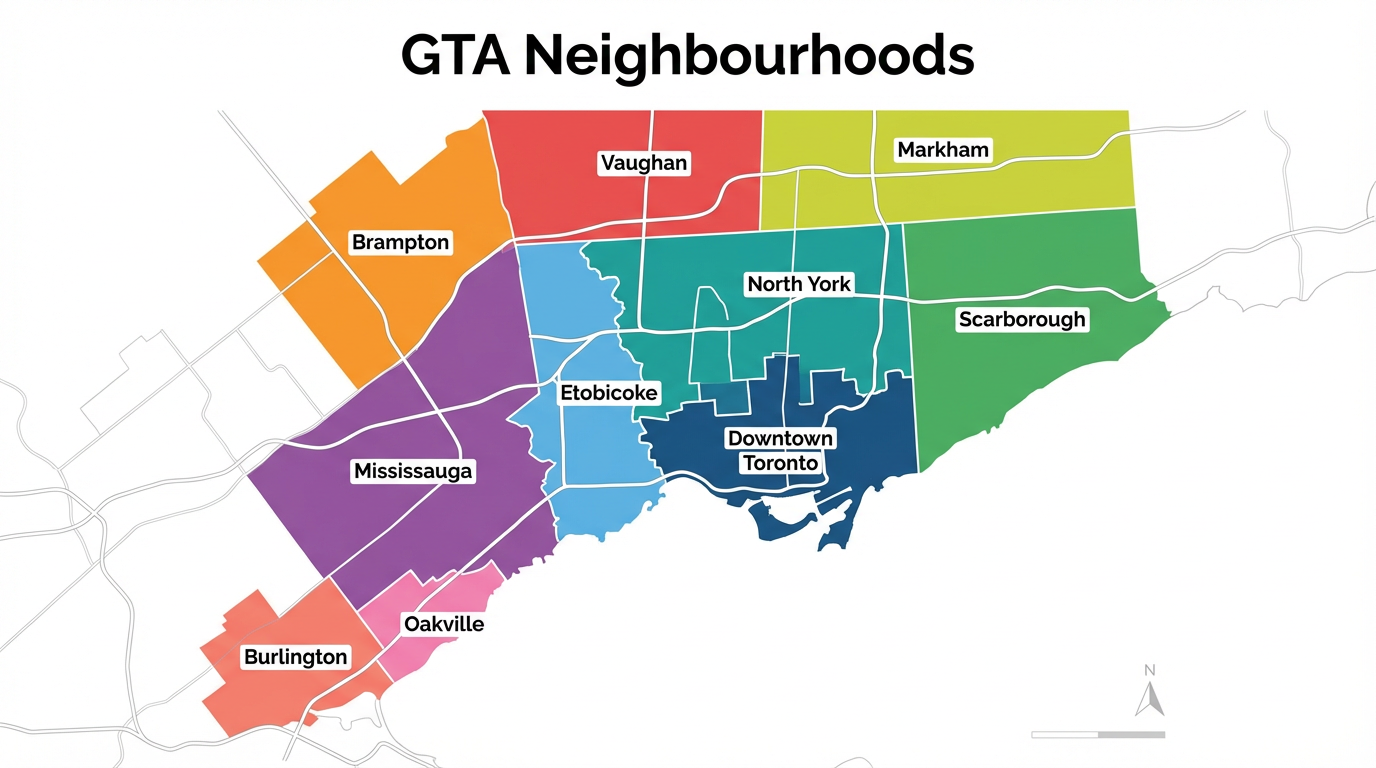
GTA Neighbourhoods by Buyer Type
The GTA stretches over 7,000 km². Choosing the right neighbourhood is the decision that matters most. We've written detailed neighbourhood guides and a full GTA comparison — here's the short version for relocators:
Young Professionals & Singles
You want walkability, nightlife, and a short commute. You're probably looking at condos.
Liberty Village / King West
$600K–$800K
Trendy, walkable, condo-heavy
Yonge & Eglinton ("Young & Eligible")
$550K–$750K
Transit hub, restaurants, mid-rise
Leslieville / Riverside
$650K–$900K
Arts scene, cafes, up-and-coming
Families with Kids
Schools, green space, and a backyard matter more than commute time. You're looking at townhouses and detached homes in the suburbs.
Oakville
$1.0M–$1.8M
Top schools, lakefront, affluent
Markham / Unionville
$1.0M–$1.5M
Diverse, excellent schools, tech hub
Burlington
$850K–$1.4M
Waterfront, family-oriented, growing
Newcomers to Canada
Community networks, cultural infrastructure, and transit access are priorities. These areas have strong newcomer support systems.
Brampton
$750K–$1.1M
South Asian community, affordable, growing
Scarborough
$700K–$1.0M
Diverse, transit-connected, value
North York
$800K–$1.3M
Multicultural, central, mixed housing
Downsizers & Retirees
You're selling a bigger property elsewhere and want comfort, walkability, and healthcare access without the maintenance.
Port Credit (Mississauga)
$650K–$1.0M
Waterfront village, walkable, charming
The Beaches (Toronto)
$800K–$1.2M
Lakefront living, quiet, community
Etobicoke (Mimico/Humber Bay)
$550K–$900K
Lake views, condo options, transit
Buying Remotely: What Actually Works
If you're relocating from another province or country, you may need to buy before you move. Here's the realistic remote buying playbook that actually works in the GTA:
Get Pre-Approved Before You Start Looking
Contact a mortgage broker (not just your bank) who works with out-of-province or international buyers. Many Canadian lenders can pre-approve you remotely. You'll need: employment letter, 2 years of tax returns (NOAs), bank statements, and government ID. Non-residents may need a larger down payment (35%).
Research Neighbourhoods Digitally — Then Narrow to 3
Use HouseIndex to browse MLS® listings with filters for price, area, and property type. Google Street View the streets. Check commute times on Google Maps during rush hour (set departure for 8:00 AM Monday). Narrow your search to 3 target neighbourhoods maximum.
Work with a Local Agent Who Does Video Walkthroughs
A good buyer's agent will do live video tours of shortlisted properties on FaceTime or Zoom. They'll show you the street, the neighbours, the parking, the light at different times of day — things photos never capture.
Plan One "Scouting Trip" (3–4 Days)
If possible, fly in for a long weekend. See your top 3 neighbourhoods in person. Drive the commute. Walk the streets at night. Visit a grocery store. This trip is for the neighbourhood, not the property — properties move fast, but neighbourhood feel doesn't change.
Make Offers with Conditions
In today's balanced market, you can include conditions (financing, inspection) in your offer. This gives you protection when buying from a distance. Your agent and lawyer handle the paperwork — most can be signed electronically.
Pro Tip: Rent First If You Can
If your timeline allows it, renting for 3–6 months before buying gives you ground truth that no amount of online research can replace. We’ve written a detailed rent vs. buy analysis to help you decide.
Closing Costs & Hidden Expenses
This is where out-of-town buyers get blindsided. Ontario has some of the highest closing costs in Canada, primarily because of land transfer tax. Here's the full picture for a $900,000 home in Toronto:
Sliding scale: 0.5%–2.5%
Toronto only — suburbs exempt
Typical range: $1,500–$2,500
Typical range: $400–$600
Required by most lenders
Sometimes covered by lender
Depends on distance and volume
First-time buyers may qualify for land transfer tax rebates (up to $4,000 provincial + $4,475 Toronto municipal), potentially reducing closing costs by $8,475. See our step-by-step buying guide for the full breakdown.
Budget rule of thumb: Set aside 3–4% of the purchase price for closing costs on top of your down payment. For a $900K home in Toronto, that's $27,000–$36,000 in addition to your down payment.
Incentives & Programs You Qualify For
Canada has multiple federal and provincial programs that can save you significant money. We've written a complete guide to Ontario first-time buyer incentives — here are the highlights:
First Home Savings Account (FHSA)
Up to $40,000 tax-free
Save up to $8,000/year in a tax-free account. Contributions are tax-deductible. Withdrawals for a home purchase are tax-free.
Official source (canada.ca) →Home Buyers' Plan (HBP)
Up to $60,000 from RRSP
Withdraw up to $60,000 from your RRSP tax-free to buy your first home. Must repay over 15 years.
Official source (canada.ca) →Ontario LTT Rebate
Up to $4,000 back
First-time buyers in Ontario get a refund of up to $4,000 on provincial land transfer tax.
Official source (canada.ca) →New HST Rebate (April 2026)
Up to $130,000
Full 13% HST removed on new-build homes. Available to all buyers, not just first-timers.
Read our full breakdown →Non-resident buyers: You may not qualify for first-time buyer programs if you haven't filed a Canadian tax return. Permanent residents and citizens qualify immediately. Work permit holders may also qualify — check with CRA.
Your Relocation Timeline
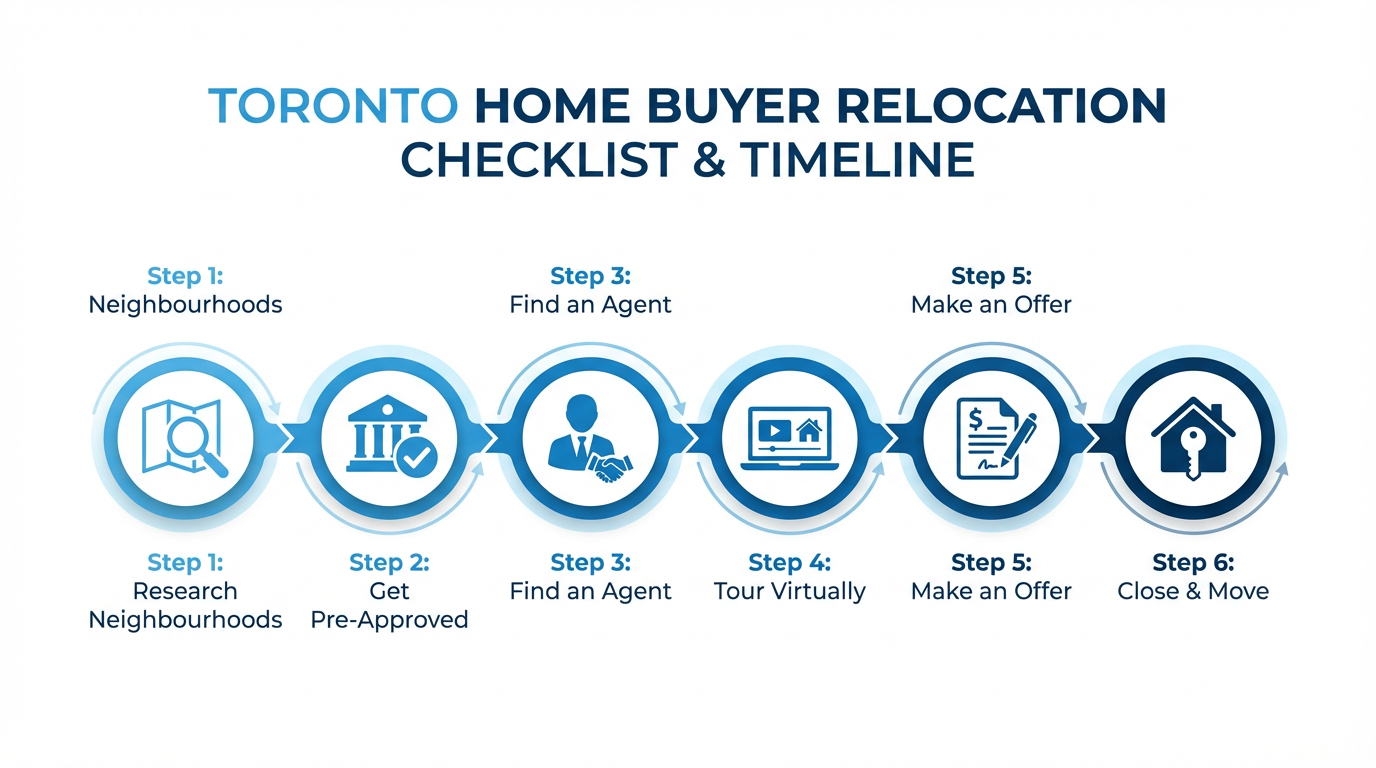
A realistic timeline from "I'm thinking about moving" to "I have the keys" is 3 to 6 months. Here's how to plan it:
Month 1–2
Research & Preparation
Research neighbourhoods, get mortgage pre-approval, open FHSA if eligible, start browsing listings on HouseIndex
Month 2–3
Active Search
Connect with a local agent, take virtual tours, plan a scouting trip if possible, narrow to 2–3 target areas
Month 3–4
Offer & Negotiation
Make offers (with conditions in this market), negotiate, get inspection done, finalize mortgage approval
Month 4–6
Closing & Moving
Lawyer finalizes paperwork, arrange interprovincial move, set up utilities, transfer licenses and health card to Ontario
Foreign Buyers & Immigration Status
Canada's foreign buyer ban has been extended to January 1, 2027. But the rules are more nuanced than the headlines suggest:
Can Buy
- Canadian citizens
- Permanent residents
- Work permit holders (with valid permit and tax filing)
- Refugees and protected persons
- Certain international students (restrictions apply)
Cannot Buy (Until Jan 2027)
- Non-resident foreign nationals (generally)
- Foreign-controlled corporations
- Buyers without a valid work/study permit
For the full picture, including exceptions and recent amendments, read our complete guide to Canada's foreign buyer ban or visit CMHC's official page.
Moving to Canada? Let's Talk.
If you're relocating from outside Canada, navigating the GTA housing market from abroad can feel overwhelming. Fill out this short form and one of our team members will personally reach out to help you get started \u2014 no obligations, no fees.
Prefer to Talk to Someone?
Whether you're moving from another province or across the world, our team is happy to walk you through the process over a quick call or email. No pressure — just friendly, honest guidance.
Frequently Asked Questions
How much does it cost to buy a home in Toronto in 2026?
The average home price in the City of Toronto is approximately $1.05 million in early 2026. Condos average around $680,000, townhouses around $850,000, and detached homes average over $1.4 million. In the broader GTA suburbs, prices range from $700,000 to $1.2 million depending on location and property type.
Can I buy a home in Toronto remotely?
Yes. Remote home buying is increasingly common. You can browse listings online, take virtual tours, get pre-approved remotely, and work with a local agent who provides video walkthroughs. Most paperwork can be signed electronically. We recommend one in-person scouting trip if possible.
What are the best GTA neighbourhoods for families?
Popular family-friendly areas include Oakville, Markham, Vaughan, Richmond Hill, and Burlington. Within Toronto, Leaside, The Beaches, Riverdale, and Etobicoke offer strong schools and community amenities. The best choice depends on your budget, work location, and lifestyle.
What are the closing costs in Ontario?
Expect 1.5% to 4% of the purchase price. This includes land transfer tax (the biggest cost), legal fees ($1,500–$2,500), home inspection ($400–$600), title insurance ($300–$500), and potential mortgage insurance. Toronto buyers pay an additional municipal land transfer tax.
How long does it take to buy a home in the GTA?
From starting your search to closing: 3 to 6 months. Pre-approval takes 1–2 weeks, active searching 4–12 weeks, and closing after an accepted offer 30–90 days.
Do I need to be a Canadian citizen to buy?
Permanent residents and citizens can buy freely. Non-residents face restrictions under the foreign buyer ban (extended to 2027), with exceptions for work permit holders, certain international students, and refugees.
Bottom Line
Relocating to the GTA is a major move, but the 2026 market is more buyer-friendly than it's been in years. Inventory is up, prices have softened, and government incentives are at historic levels. Do your research, get pre-approved, and take advantage of the window.
Data Sources
All data sourced from Canadian institutional and government publications:
- • Canada Mortgage and Housing Corporation (CMHC) — Housing market data
- • Statistics Canada — Housing & population statistics
- • Canada Revenue Agency (CRA) — FHSA, HBP, tax credits
- • Government of Ontario — Land transfer tax, HST rebate
- • Toronto Regional Real Estate Board (TRREB) — MLS® market data